


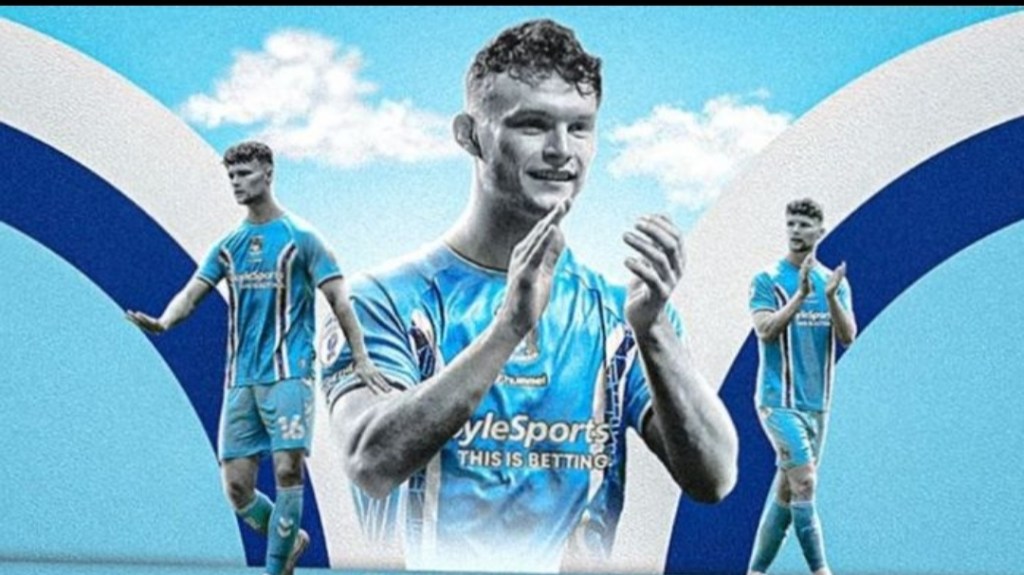
Luke McNally: Irish centre-back looking forward to the richest game in football.
“Everyone’s buzzing,” he beams. And with a shake of his head, he reiterates: “Everyone’s buzzing!”
23-year-old Luke McNally comes inside after training and sits with Coventry City press officer Alex for a zoom interview with Ireland Radar.
Coventry have just completed their final full-intensity training session ahead of the richest game in football and the smile stretched across McNally’s face gives the excitement away.
Winning the play-offs was a remote possibility for Coventry when the Meath man joined on loan in January, but since then they have lost just twice, keeping twelve clean-sheets in the process.
By somehow climbing from fifteenth to fifth place in the Championship standings, and then upsetting Michael Carrick’s Middlesbrough in the play-off semi-finals, Premier League football is suddenly in their sights.
McNally excited by Wembley play-off final
“Everyone is wanting to get the game started and just get going in the game,” explained the 6’4 defender on Thursday afternoon.
“It’s been a long wait to be fair. It feels a long time since the semi-final. We’re all just looking forward, we just want to get out there now.”
Only a few Irish footballers ever fulfil their childhood dreams of playing big games at big stadiums – and McNally admits he didn’t think he would be one of them.
But this weekend he will be richly rewarded for years of steady progress when he graces one of the most famous arenas of them all: Wembley Stadium.
“You know yourself with Irish people, they come in numbers really for sporting occasions so it’s nice for my family to see me playing at Wembley,” he said.
“I have a lot of Irish coming, I must have forty people from Ireland coming on Saturday so yeah no it’s exciting.
“I wouldn’t have thought that [was possible] maybe a couple of years ago so it’s exciting.”
Luke McNally: From LOI academies to Wembley Stadium
Five years ago when McNally was taking his first steps into League of Ireland football, Coventry found themselves playing down in League Two for the first time since 1959.
The club’s rise since then has been remarkable, but so too has McNally’s. Progressing via Enfield Celtic, Drogheda United, St Patrick’s Athletic, League One side Oxford United, and a half season of minimal gametime with parent club Burnley…this moment has been hard earned.
Despite its many documented flaws, Ireland’s domestic game was an important launch pad for McNally’s career and, as someone who spent the entirety of his academy years in the League of Ireland, he was enthusiastic to speak about how well it set him up for a successful start to life in England:
“I thought it was really good,” he said. “The year I went to the First Division [on loan with Drogheda] was definitely really good for me. It just toughened me up. You’re playing against bigger lads. In that league a lot of them are part-time so they’re heavier than what I’m going up against now!
“It’s much harder, you get more target players [to defend against] and then when you come to England that’s not the hard part, really. When I got here I felt confident in duel situations and tackling and all that sort of defensive work.
“I felt I got good practice with it in Ireland so that set me up a long way and then when I came to England there’s more emphasis on possession, which was good. When I was in Pat’s academy, to be fair, we got a good dose of that so yeah, I kind of just have a mix of everything and it’s been a big help playing in the League of Ireland, for sure.”
Ireland underage pathway.
The role of League of Ireland academies in the development of Irish players is a hot topic at the moment as, although teenagers can no longer join British clubs until they turn eighteen due to Brexit, Irish underage sides are still performing admirably with homegrown squads.
The Ireland under-17s, for instance, qualified for the European Championship quarter-finals by beating Hungary 4-2 on Tuesday evening and all four goals came courtesy of players from McNally’s old club St Patrick’s Athletic.
The lack of investment in Irish football would suggest that the underage teams shouldn’t be so good – but they are – a reality McNally puts down to the National League format enforced by former FAI High Performance Director Ruud Dokor.
“I’ve heard it talked about a lot the last couple of weeks around facilities and what we can do for players…”, he pauses and thinks…”It’s a tough one.”
“I think the schoolboy system has always been strong in Ireland and there was a need to bridge that gap from the schoolboys into senior football. I think it’s really beneficial.”
Doktor’s divisive Dutch model sees League of Ireland academy teams sign the best players from various schoolboy clubs. These teams then compete in their respective under-19, under-17, under-15 and under-14 competitions against other talented League of Ireland sides.
As a departure from the old decentralised approach which saw player development left in the hands of schoolboy clubs, the move was contentious at the time, but is now proving beneficial on the underage international stage, just as it proved beneficial to McNally’s career.
“I didn’t move to England until I was maybe 21 when I went to Oxford,” the centre-back continued, “so I played a lot in Ireland and it will be a similar route for the lads playing in the 17s. They have a lot more talent than when I was that age but I think it benefited me a lot and I think it will benefit them a lot.”
“Obviously Evan Ferguson is a good example,” suggested McNally. “He played first team football really young then got his development at Brighton on the ball and sharpened his skills. But ultimately when you’re playing professionally in any league there’s a standard of competitiveness and physicality that you have to match and that’s the biggest question, I guess.”
The question that many pose is whether this first wave of post-Brexit Irish youngsters will continue to compare so favourably to their foreign peers when they are seventeen or eighteen.
The development of Ferguson is an example of how UK academies can help Irish players in that age bracket – he was eligible to make the switch at sixteen because of his English mother. However, the Ireland international had his first experiences of men’s football while with Bohemians.
“Academy graduates from over in England probably don’t get asked [to play in their first teams when they’re younger] whereas Irish lads will now just be thrown into it. The likes of [Mason] Melia at Pat’s – I see he’s flying – he’ll be chucked in playing with senior players.
“That will only make him better, but then when you get to seventeen, eighteen, when a lot of them progress, that’s when they need to bridge the next one and that’s probably the biggest task.”
McNally on Vincent Kompany and Burnley.
Although the League of Ireland prepared McNally to excel in League One with Oxford United, he found that much more work was needed in order to become a top player for Burnley. An indicator perhaps, that we will see a trend of Irish ‘late bloomers’ in the coming years.
Under the guidance of the legendary Vincent Kompany, the Meath man was able to identify blind-spots in his game and felt he came along “miles” during the first half of this season at Turf Moor, despite seeing very little gametime.
“I wasn’t playing as much but with how well Burnley have done I didn’t have a million complaints. It wasn’t a question of me banging on the manager’s door every week because they were just winning every week.
“But to be fair, I learned a hell of a lot. Working under Kompany just bought my game along miles, even though I was frustrated with not playing. I missed the feeling cause I was used to playing with Oxford, at Pat’s, at Drogheda; I was used to just playing games and that’s what everyone wants to do.
“That was frustrating but to be fair it was like learning your theory for the driving test – I was learning things all the time in training that definitely made me a better player.”
“He’d treat every player equally whether you are his captain or if he wasn’t putting you in squads. If he (Kompany) had seen something you needed to improve he’d tell you, no matter how important you are to the team. That just brought me on loads.”
The next level.
As exciting as McNally was at Oxford, the player seen for Coventry in recent months has looked more mature and polished. That shouldn’t come as a surprise either, considering the knowledge four-time Premier League winner Kompany would have shared with him between July and February. Insight you just can’t get in the League of Ireland or League One.
An improved McNally made the Championship Team of the Round on three different occasions during the regular season, showcasing his ability to not just play in England’s second tier, but to excel in it.
Although his parent club are already promoted, a win for Coventry would double his chances of featuring in the top flight next season – and for the kid inside every Irish footballer that, really, is what it is all about:
“It would be unbelievable. Just the occasion would be brilliant. What will be, will be…the way I look at is ‘what will be, will be’.
“It’s been a brilliant season and it would be great to top it off. It’s a cup final in a way so anything can happen on the day.
“Hopefully we get that bit of luck and perform well.”
If more Irish youngsters can be like Luke McNally, we’ll be doing just fine.
 Ireland Radar